Nevada Traffic Research & Education Newsletter
MARCH 2021 // VOL. 10, ISSUE 02
Disponible en español

Nevada’s highway speed limits vary throughout the state. In urban areas, speed limits are up to 65 miles per hour. In rural areas, speed limits can be set up to 80 miles per hour. The Nevada Department of Transportation maintains a map of the speed limits on the state-maintained highways and interstates, which can be viewed at www.dot.nv.gov/travel-info/maps/state-maps
TREND In Focus: Graduated Driver Licensing
Crash and Trauma Outcomes for Motor Vehicle Occupants
By Laura K. Gryder, MA; Samantha A. Slinkard-Barnum, MPH; Deborah A. Kuhls, MD
Vehicle speed is a major contributing factor to crashes and related injuries. The faster a vehicle is traveling, the more likely the driver may: 1) lose control, 2) require more time and distance to stop, and 3) experience increased crash and related injury severity.[1] Speeding contributed to nearly one third of all fatal crashes nationwide in 2018, killing an average of twenty-five people per day.[2] In Nevada, speeding contributed to the deaths of 180 road users between 2018 and 2019.[3] This TREND in Focus analysis investigates the relationship between speed, crash severity, and injury severity for motor vehicle occupants presenting to any of Nevada’s four trauma centers between 2015 and 2017 following a crash on a highway with a posted speed of 55-65 MPH or 70+ MPH (N=2,324).
Results
Crash Factors:

Driving over the speed limit was a factor in 30% of crashes on highways with posted speed limits of 55-65 MPH and 38% of crashes on highways with speed limits over 70 MPH. Figure 1 shows a comparison of various significant factors for motor vehicle crashes on highways with 70+ MPH speed limits compared to 55-65 MPH limit highways. Drivers on 70+ MPH highways were significantly more likely to be drowsy (14.1% vs. 3.0%), distracted (3.9% vs. 1.6%), unrestrained (20.3% vs. 10.7%), ejected from their vehicle (10.6% vs. 3.8%), and overcorrect their vehicle (16.4% vs. 5.6%) compared to drivers who crashed on 55-65 MPH highways.
Injury Outcomes and Hospital Resource Utilization:
Patients who were involved in crashes on 70+ MPH highways experienced significantly higher median hospital charges (Figure 2), more severe injuries (mean Injury Severity Score 8.23 vs. 4.29, Figure 3), and more time in medical care (Figure 4) compared to those injured on lower speed highways.
Hospital Disposition Outcomes:
Patients injured on higher speed highways (70+ MPH) more frequently died from their injuries or required skilled nursing or rehabilitation after their stay in the hospital (Figure 5).


TREND in Focus: References
- Speeding. National Highway Traffic Safety Administration. https://www.nhtsa.gov/risky-driving/speeding
- Motor Vehicle Safety Issues: Speeding. National Safety Council. https://injuryfacts.nsc.org/motor-vehicle/motor-vehicle-safety-issues/speeding/
- Nevada Fatal Crash Dashboard: Speeding Related Crashes. Nevada Office of Traffic Safety Zero Fatalities. https://zerofatalitiesnv.com/
Spotlight
Nevada’s 81st Legislative Session
By Samantha A. Slinkard-Barnum, MPH
Nevada’s 81st legislative session began on February 1st, 2021. Our team has been hard at work providing ad hoc data analyses and legislative fact sheets to inform several traffic safety-related bill drafts for the state Senate and Assembly. We have been following several bill drafts in particular: The current text for each of these bill drafts can be accessed through the Nevada Electronic Legislative Information System (NELIS), and we provide a brief overview of these bills below.
- AB79: Revises the requirement for certain applications for a driver’s license
- AB118: Revises provisions governing transportation of children in motor vehicles
- SB170: Makes changes relating to off-highway vehicles
- SB183: Revises provisions relating to transportation
The current text for each of these bill drafts can be accessed through the Nevada Electronic Legislative Information System (NELIS), and we provide a brief overview of these bills below.
AB79: This bill revises the number of hours of supervised experience a young driver aged 16 or 17 needs to complete before they may apply and test for a driver’s license. It expands upon a bill passed during the 80th session (2019) which required that young drivers, if they are able, complete a hands-on defensive driving course before they receive their license. AB79 will require that young drivers complete the defensive driving class and a minimum of 50 hours of supervised driving OR at least 70 hours of supervised driving.

AB118: This bill will modify the laws pertaining to child restraint systems (i.e. car & booster seats) to better align with American Academy of Pediatrics recommendations. We discussed those recommendations in TREND 8.4. AB118 will increase age and height requirements, remove the weight requirement, and require that children <13 years old ride in the back seat of a vehicle. Our Co-PI, Dr. Chestovich, along with other partners in traffic safety, provided legislators evidence- based testimony for this bill. Access our fact sheet here.
SB170: This bill will make changes to the registration requirements for off-highway vehicles, such as dirtbikes or all-terrain vehicles, and more importantly, require children under 16 years old to wear a helmet when operating, using, or riding these vehicles. Access our fact sheet for more information.
SB183: This bill proposes changes to speed limits and the use of bicycles (motorized and non-motorized) and electric scooters on Nevada roadways. As introduced, this bill would allow increased speed limits in high occupancy vehicle (HOV) lanes up to 5 MPH over the posted speed limit (fact sheet). SB183 also will prohibit the use of bicycles and scooters on roads with speed limits of 65 MPH or greater, and place a limit of two cyclists riding “abreast” (side by side) on the shoulder of a roadway.
Our team will be tracking these bills and any others that are introduced throughout the legislative session. Legislation to improve traffic safety is a vital piece of the puzzle to encourage safer driving behaviors and road design.
Interested in getting involved in the Nevada legislative session?
You can read proposed legislation (via NELIS), join committee meetings virtually as a guest, submit opinions, and find other information about the legislative session at https://www.leg.state.nv.us/
At Home with the Traffic Safety Research Team
#DriveSafe, Don’t Take a COVID Patient’s Place Campaign Series
By Merika Charupoom and Emily Carter
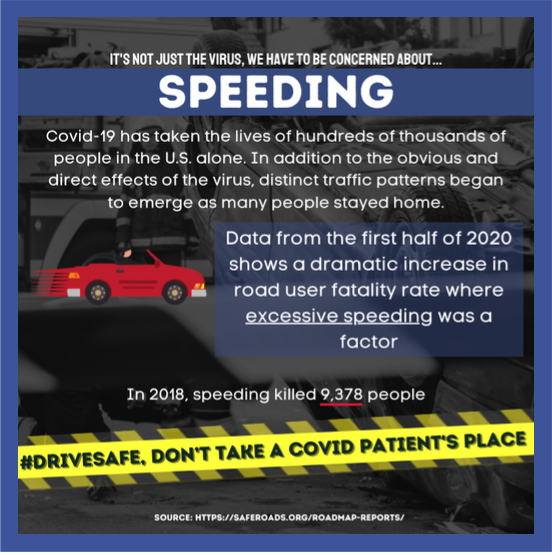
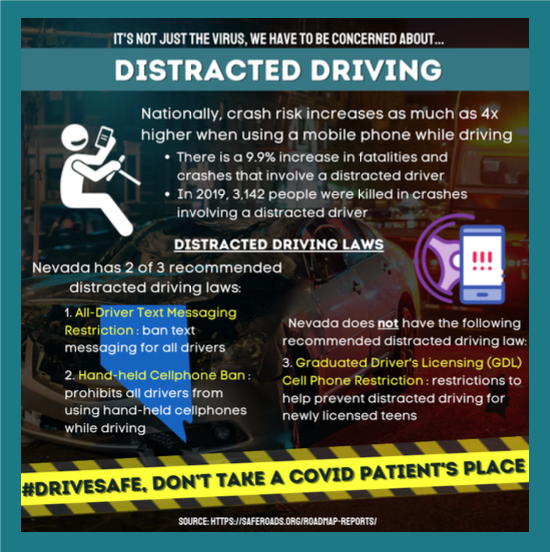
Staying home during the COVID-19 pandemic has given rise to distinct traffic patterns and trends on national and Nevada roadways. Among these trends, excessive speeding on roadways due to diminished traffic volume during the COVID-19 pandemic persists as an increasing problem. Other dangerous behaviors observed during this period include distracted driving, impaired driving, and unbelted occupants. Our team created a social media campaign on four driving behaviors (speeding, seat belt use, and impaired & distracted driving) as a way to help spread the message that safer driving behaviors will save hospital beds for COVID-19 patients.
Nationally, data from the first half of 2020 indicates an increase in roadway fatalities with speeding as a contributing factor. This emphasizes the importance of addressing the issue of speed. Additionally, there is a reported increase in crash risk when the motor vehicle occupant is using a mobile device. Distracted driving continues to be a major precursor to roadway fatalities. Currently, Nevada is one of 17 states that does not have all of the recommended distracted driving laws.
Furthermore, there is an increasing trend in unbelted motor vehicle fatalities on the national scale. Seat belt compliance is higher in states that have a primary seat belt law. Using seat belts reduces overall risk of injuries by 50% (SafeRoads). Currently, Nevada has a secondary seat belt law. Overall, impaired driving continues to be a preventable leading cause of motor vehicle crashes.
As more of our population is vaccinated, it is important to continue to be cautious on the road. Planning ahead, being alert, and following the law are all good safety precautions we can collectively take to help save hospital beds for COVID-19 patients.


Staff Feature
Merika Charupoom

Merika Charupoom is a Student Researcher engaged in Traffic Safety Research at the University of Nevada, Las Vegas (UNLV) School of Medicine since October 2020. Merika is currently an undergraduate at UNLV pursuing a bachelor’s degree in Public Health and minor in Biological Sciences and Mathematics. With her focus in Public Health, Merika contributes to the traffic safety research team’s work in safety intervention and injury prevention. Merika’s work includes being social media management, data analysis and visualization, and project presentations. Being born in Thailand, Merika aspires to become an Obstetrician and serve her native community. Having worked with this team, Merika has developed an interest in research and social media communication strategies. Outside of the UNLV Traffic Safety Research Team, Merika enjoys painting, embroidering, baking, visiting local museums, and spending time at home with her family and friends.
Sign up to receive our Trends Newsletters by email!

GET IN TOUCH
Data Partners




Funding Statement
Funding for this project comes from the Nevada Department of Public Safety‐Office of Traffic Safety.
Grants:
#TS-2019-UNLV-00089
#TS-2019-UNLV-00149

